Wednesday, January 15, 2014

Unconscious Biases: In Your Biased Opinion...

Are you biased towards employees or coworkers? You? Of course not, but I'm not only talking about gender or race bias. Biases can be much more nuanced than we think. In fact, they may be so nuanced that we don't even know they exist. According to The Wall Street Journal, we all have biases and they can often subconsciously affect decisions.


Biases we may not detect in ourselves that can affect our attitudes towards others include judgments on how people dress, look, speak, act, smell, sound, or even walk. One might think a quiet individual disengaged or disinterested, while they are actually intensely thinking or contemplating a comment or strategy. Many of us over a certain age may find tattoos, piercings, or other body jewelry surprising to see visible in the workplace while younger generations don't even notice.

Cook Ross, Inc. provides "Unconscious Bias" training for businesses: "For years it has been clear that people make decisions every day that impact some groups more negatively than others: decisions about hiring, about purchasing, about promotions, about job assignments."


Large corporations are catching on - "As many as 20% of large U.S. employers with diversity programs now provide unconscious bias training, up from 2% five years ago." With this upward trend, it's likely that this type of employee training will reach 50% in the next five years.

The take away from all of this is the old adage:
"Judge Not Lest Ye Be Judged."

Monday, January 13, 2014

Men: A Correlation Between Personal Relationships with Women and Work Relationships with Women?

Poodlesrock/Corbis
As a first born daughter whose father was also my business partner and company founder, this article in December’s Atlantic resonated with me.

The article, “How Women Change Men,” reveals a correlation between men’s relationships with women at work based on their personal relationships with women.

For example “male CEOs with firstborn daughters actually pay their employees more, giving female employees the biggest raises.” Furthermore, “Men who have daughters also grow less attached to traditional gender roles…”

You can read the entire article here. Check it out and see if you agree with the findings.

- Dawn Reshen-Doty, President

Tuesday, January 7, 2014

The Consumer Electronics Show

If you can’t seem to find any of your tech friends this week, it’s likely because they’re attending the Consumer Electronics Show (CES) in Las Vegas. According the WSJ, wearable gadgets are flooding the CES. It might be time to start lifting weights to strengthen those wrists for these novelty gadgets. Read more about the future of this emerging technology.

Thursday, January 2, 2014

Don't Start 2014 Off-Key: Why You Need Key Person Insurance

2014 is upon us. You and your partner(s) have created and now run a successful business. You have business insurance, liability insurance, property and casualty, health, unemployment, and what must seem like a mountain of other policy coverage depending upon your specific industry requirements. What's often overlooked in many instances is key person insurance, also known as key man insurance.

Colin Aiken, Assistant VP of the Life & Benefits Division of Emery & Webb, Inc. best sums up the objective of key man insurance; "It is to provide funds to recruit, select and train a key employee's
replacement, replace lost profits and continue the confidence of customers, creditors and employees." Simply put, it is life insurance to cover financial losses in case of the death or incapacity of an important or "key" member of the business. It typically is in place only during the tenure of a key individual, should their inability to work cause potential major financial losses or business interruption due to their absence or death.

Many members or partners bring a specific and often unique skill set to a business: one might be the rainmaker in the business, with substantial contacts and networks that feed the growth of the business; another with an extensive history or knowledge in a certain field, and another might be someone who handles a specific area of expertise or concentration of your business that would be hard to replace and therefore have an immediate or substantial impact to your bottom line should death or an accident occur.

Macabre as it might seem, it's essential to the stability and future planning of an organization with more than one partner, and is a business coverage and expense that you should not be without. Typically it's thought of as an economic bridge to tide over the company's potential loss of income until an individual can be replaced. The policy is always treated as an emergency coverage for lost earnings and is for specific amount of money rather than a revenue source. It is also usually paid for and owned by the business itself.

What's little known is that this type of insurance is often portable or convertible. The individual insured can take this life insurance policy with them if they should leave the organization. The policy, assuming it has been in place long enough to accrue value, can also be sold, which is a life settlement. Typically this is done by older individuals who are looking for an immediate cash settlement and their policies are considered a current asset. The prices paid for these policies can range from 10 to 75 percent of the death benefits.

Many of these policies, if in place for a longer period of time, are cheaper for an individual to request their company to release to them personally rather than going back into the insurance marketplace to acquire life insurance at an older age, which means a more expensive policy. Key person insurance can be also used as deferred executive compensation. Always check with your accountant when setting up these plans with your insurance agents as they are considered assets of your business and have tax ramifications both on the personal and business level.

So there actually is an insurance policy that can be used before you die-imagine that! But on that note: here's to your health and happiness in 2014. Happy New Year to all our clients, colleagues, and friends.

Thursday, December 12, 2013

2014: Essential Tips for the Year Ahead

Everyone wants each New Year to be better than the last. To do so, instead of setting broad, generic resolutions, it might be more effective to take small, simple steps to tackle 2014. We have approached some of the most trusted colleagues and associates of Benay, who are movers and shakers in their own industries, to tell us what they feel is most important for a business to focus on in the new year.

We have included a sampling of some of their responses in Benay's "user's guide" to help you best navigate 2014 based on the current the marketplace.


The Benay Way


All of these tips come from the wonderful business colleagues and resources of Benay and Benay clients to boot. We wish all of our clients, colleagues, and friends the happiest of holidays and continued success in 2014.

Wednesday, November 20, 2013

Time Is On My Side - Yes, It Isn't

As a small business owner, I've learned the importance of grabbing your audience's attention as quickly as possible.Attention spans are short these days, especially when it comes to digital content. According to recent market research:
And the most shocking statistic of all: The average person's attention span in 2012 was only 8 seconds.

So as a business professional, what can you do to keep your audience's and employees' attention for longer than eight seconds? One of the most effective ways is to compile information in an easy to understand, entertaining way. A new slideshow platform,PechaKucha, solves this conundrum. According to an article in Inc. magazine, "The rules are  beyond simple. Speakers display 20 slides and spend 20 seconds on each. If you have more than 20 points to make: too bad. Cut some." Ruthless? Maybe. Effective? Definitely. Next time you or one of your team members needs to give a presentation, try utilizing the PechaKucha method, and watch as others listen intently and engage with your ideas.
Looking to start a new business? Have you spent hours working on en executive summary that trails on for pages and pages? Is the marketing plan exponentially growing? Well, stop. Instead of writing a novel about your business, make a "deck."According to Eric Paley in Inc. magazine, "No matter how gifted a writer you are, slide presentations, or decks, are a better way to get your message across." Investors and potential partners will be more likely to follow along with your slideshow presentation than read your ten-page business plan. Writing a business plan is a good way to organize and formalize your ideas but a slideshow presentation will be a more enticing, succinct way to garner support and funds.
The moral of this newsletter is that less is always more. Keeping attention while piquing interest is the challenge we all face in today's digital world.

Wednesday, November 6, 2013

Stuck in the Middle With You: Baby Boomers vs. Gen-X vs. Gen-Y

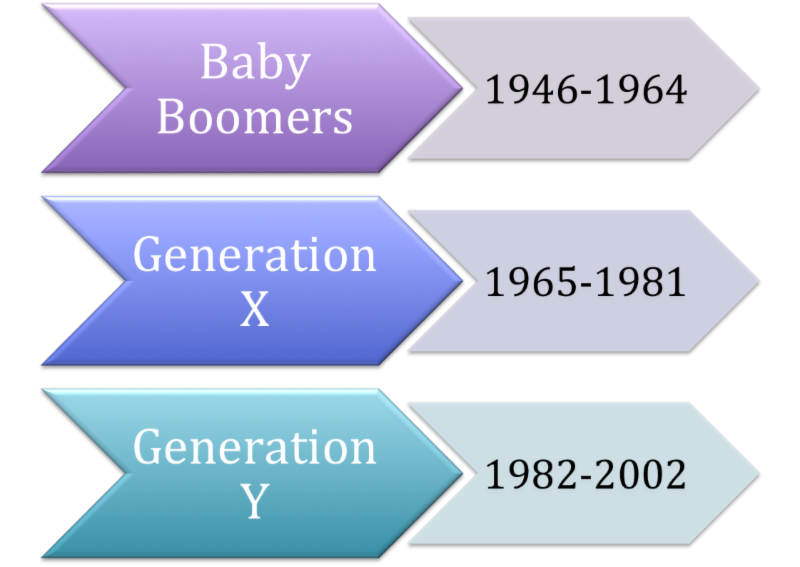
The Great Recession of 2008 continues to play a large role in today's job culture. Baby Boomers, Gen X-ers, and Gen Y-ers alike are all feeling the effects. Many Baby Boomers have postponed their retirement plans, holding onto their senior positions, and making it harder for Gen X-ers and Gen Y-ers to move into the workforce, let alone move up the company ladder.
Generational Work Styles
Many studies and much research has been done regarding each generation's work-style and their positives and negatives. Baby Boomers may be most likely to hold senior positions due to age. Positives? Most likely to be loyal. Negatives? May lack adaptability. Gen X-ers may be the best team players but rank lowest in cost effectiveness and having executive presence. And Millennials may be the most tech savvy and enthusiastic about their jobs, but rank lowest on being team players.
As Baby Boomers slowly move out of the workplace and the Millennials begin flooding in, managers and leaders will do well to learn how to effectively motivate and manage Gen Y-ers.
Gen Y-ers may be the most brash and overconfident generation yet. "They tend to enter the workforce with very high expectations both for themselves and for their employers, and they often have plans to effect change at their company from day one." Thus, it's important to foster their need for stimulating work that allows them to grow.
The Millennials are often referred to as "the boomerang" or "Peter Pan" generation. About 28% wwill move back in with their parents after college and not become fully independent until their 30's. This leaves Millennials a lot of opportunity to job hop and find the one they're most compatible with. "This lack of fear about holding on to one job tends to make them outspoken and unafraid of the boss."
In turn, Gen Y-ers should take a step back and realize that a green employee will not necessarily be able to change the company right off the bat, even with that "ground-breaking" idea. It's also important for them to be reminded of the old adage, "don't burn bridges." Having unrealistic expectations in a work environment can have repercussions - many career opportunities are made by on-the-ground networking and Millennials will do well to create professional relationships.
Obviously these are generalizations, but recognizing other generations' work traits, wants, and needs can help everyone succeed in their personal careers as well as benefitting the company as a whole. As Mark Smither, VP, Strategic director for Paulsen Marketing said, "Multiple generations working together makes for a better work environment and better end product to customers."
The graph below summarizes the strengths and weaknesses of each generation.   
Graph stats taken from: "Here Are The Strengths And Weaknesses Of Millennials, Gen X, And Boomers" by Vivian Giang. September 9, 2013. 

"Leadership is not about titles, positions or flowcharts. It is about one life influencing another."
- John C. Maxwell