Showing posts with label New York Times book review. Show all posts

Monday, April 14, 2014

Tin House Books' Newest Release "The Dismal Science" is Highly Reviewed in the NYTimes Book Review

Tin House’s (Benay Client) newest book received a rave review in the New York Times Book Review.  “The Dismal Science” by Peter Mountford is replete with Dante references and homages with “Purgatory [as] the underlying structural metaphor of the novel.”


The story follows Vincenzo D’Orsi, a 54-year-old banker as he leaves his cushy corporate job due to moral differences, as the bank will cease funding to Bolivia if the leftist candidate, Evo Morales, wins.  D’Orsi believes this goes against the mission of the company and gives the story over to a reporter friend. The story blows up and obviously D’Orsi’s career with the bank is over. To further his spite against his former company, D’Orsi chooses a new job with Morales’ public relations officer and chooses to give a speech on Morales’ behalf.

“Peter Mountford’s fierce imagination and intelligence drive ‘The Dismal Science’…Though many of the themes examine a darker shade of human nature, Mountford manages to infuse hope.” As D’Orsi traverses the new adventures life has laid out before him, it becomes apparent that Dante and Machiavelli is a driving force behind his (and Mountford’s) intellectual thought.  “They are integral to his attempt to make sense of where he is and reflect on the geopolitical landscape of 2005, shaped senselessly by the erratic nature of human behavior.”


Martha McPhee couldn’t have been more pleased with “The Dismal Science.” Her analysis and interest in the themes make the book a desirable read. We wish Tin House Books and Peter Mountford the best of luck as “The Dismal Science” (hopefully) takes the literary world by storm.


You can purchase a copy of the book through Tin House’s website.

Monday, March 3, 2014

Soho Press' "Murder in Pigalle" in the New York Times Sunday Book Review

Benay client, Soho Press, has a new title reviewed in The New York Times Sunday Book Review. The crime novel by Cara Black, Murder in Pigalle, will be released this month through Soho Crime. Muder in Pigalle is number 14 in the Aimée Leduc series. This time the detective chases down a serial rapist while six months pregnant. Read the New York Times review and preorder the book here.

Monday, April 29, 2013

Soho gains further repute through Times review of "The Tooth Tattoo"

Official cover for The Tooth Tattoo
Benay’s client Soho Press landed yet another laudable review in the April 21st Sunday New York Times Book Review, with the recent release of Peter Lovesey’s The Tooth Tattoo out of their crime imprint. Times Reviewer Marilyn Stasio calls Lovesey’s newest work an “ample display” of his oh-so characteristic “droll humor.” As it goes with most crime fiction, Lovesey’s novel deals with the mysterious murder of a young woman who fits the bill for the classic victim; a young Japanese music lover who has traveled all the way to Bath, England to fulfill her dream of witnessing a world renowned string quartet.

Yet, perhaps as is (again) characteristic to crime novels, not much is what it seems; a statement applicable both plot-wise and stylistically. The novel starts out as such:
 
“Eleven-thirty at night, sweaty in his evening suit and shattered after a heavy night playing Rachmaninov, Mel Farran plodded out of the artists' exit on the south side of the Royal Festival Hall. Good thing his legs didn't need telling the way to
Waterloo station and the tube. He'd done it a thousand times. Rachmaninov
was said to be the ultimate romantic—miserable old git. The six foot scowl,
as Stravinsky called him, had been a pianist through and through. He worked
the string section like galley slaves to show off the joanna man, and Mel
Farran was a viola-player, so thank you, Sergei.”


Soho Crime author, Peter Lovesey
It is apparent straight from the beginning that Lovesey holds no pretense. For all we know, we are as good as sitting in a theater seat watching the scene unfold in front of us with Lovesey right beside us, in whispering the narrative in our ear as it goes. It is a refreshing way to read, to say the least, and impressive in its let-me-guide-you-while-you-lead mentality.

The accessibility of Lovesey’s writing is only furthered by his cavalierness in the face of ostentation – which is perhaps apparent from the passage above. There’s much of it to spare in the elite world of classical music (at least in Lovesey’s world), and the fact that he takes the back-door perspective through the eyes of the “lowly” viola player, as opposed to the star pianist, says a lot about his character as an author. It’s one of the many things that truly solidifies a readership for an author, and is yet another testament to Soho’s outstanding judgment in choosing their authors.
 
View the comprehensive excerpt from The Tooth Tattoo by visiting the book's page at the Soho website. You can find more of Peter Lovesey's titles at his page on the Soho website as well.

- Colleen McClintock

Monday, March 18, 2013

Tin House and Granta Set the Gender Bar for Publishers Nationwide


Could we be any more proud of our clients?  After seeing the official results from the March 4th VIDA count, probably not.  Benay clients Tin House and Granta were rated by VIDA as two of the most progressive publishers these days when it comes to gender equality.  Out of the fifteen that were reviewed by VIDA they and the Boston Review were the only ones to find that they were balanced between men and women in editors, reviewers, contributors, and otherwise.  The remaining twelve were shown to be starkly in favor of women.
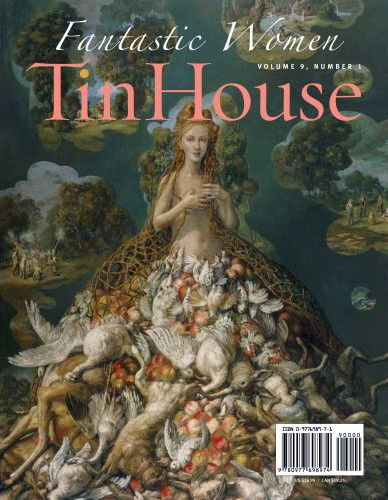
The "Fantastic Women" issue of
Tin House, issued Fall 2007
“It isn’t rocket science” – the very words of Tin House Editor, Rob Spillman as quoted in a recent article on the pop culture blog, Flavorwire.  Spillman states, “…you would think others would move toward gender equality, or at least make a gesture toward it… for us the VIDA count was a spur, a call to action.”

How right he is.  The numbers of the VIDA count were dismal in many cases.  The New Yorker results showed roughly two and a half times as many men were employed in all categories; The New York Review of Books was even more imbalanced at around five times as many male contenders in all categories.

Not surprisingly, Tin House was singing somewhat of the same song not too long ago.  The difference is in the way they handled it.  The editorial team saw that even though they asked for an even split of writers to cover, people just kept writing more about male authors.  So what did they do?  They did what any truly proactive, progressive publisher would do – they got über deliberate.  Spillman and his team decided to section off a chunk of time every editorial meeting to re-evaluate the gender balance.  If it is off-kilter they fix it.  It’s as simple as that, no fuel cell chemical equation required.

Those over at Granta take an even simpler approach; they take gender out of the equation altogether.  For Editor John Freeman it is not a matter of the best female writers and the best male writers featured in his magazine, it is the best writers.  He seems to find that middle part erroneous.

“I don’t force myself to think of Louise Erdrich, or Karen Russell,” Freeman says in the Flavorwire article. “In fact, it is hard for me not to [think about them]; to me, they are simply the best out there.”
American Dream Machine author
Matthew Specktor with his daughter.
Now it is not as if this means that the writers at Tin House and Granta, respectively, are chosen out of gender equal merit.  Matthew Specktor’s novel American Dream Machine set to release from Tin House next month hardly holds any female characters at all.  It is a story, told from male protagonist Nate Rosenwald’s point of view, about his one-time successful talent agent father Beau Rosenwald.  Nate relates the story of his father’s personal reinvention as he starts up his own agency, the American Dream Machine, with friend and consequent business partner, William Farquarson.

It is a son-and-father tale to beat the best of them, and there is nothing wrong with that.  As a recent review of Specktor’s novel on bookbrowse.com says, this novel may be all about men but it is by no means only for men.  In the novel Nate narrates with a distinctly authorial voice, channeling Specktor himself when he says, “This story… isn't about some bored actress and her existential crises, a troubled screenwriter who comes to his senses and hightails it back to Illinois. It's not about the vacuous horror of the California dream. It's something that could've happened anywhere else in the world, but instead settled, inexplicably, here.”

Hearing the novel put in this light, it isn’t really surprising, then, that it’s coming out of Tin House.  It could happen to anyone - it is applicable to anyone, un-biased and free from pretense.

- Colleen McClintock


Monday, March 11, 2013

Soho Press's Cara Black has done it again - and this time in Montparnasse!


Murder Below Montparnasse
author, Cara Black
I think it’s a bit indisputable that today’s generation of young Americans very accurately channels the wily ex-pats of the 1920s.  Frankly, we pride ourselves on it.  Any of my friends would give anything to romp around the glowing Paris streets at night, sipping Sazerac to their hearts delight, dancing with Djuna Barnes, and musing to F. Scott and Zelda about what is to be young and alive.  They are sensibilities that we can’t help but feed into; it’s the artist in all of us!

This is precisely why, when I say Cara Black’s new novel Murder Below Montparnasse has nailed it, I’m talking down into the floorboards for good.  Black takes all of the young dreamer sensibilities that are relevant today and mixes them with her characteristically elusive, keep-you-guessing style to create a new and exciting genre of literature that’s at once accessible and complex.

Marilyn Stasio lauds Black in her recent New York Times book review, calling Montparnasse a neighborhood, “rich… for the purposes of a plot that hangs on a Modigliani canvas and involves Russian émigrés and Surrealist artists…” – and boy is she right.  Montparnasse is historically one of the most artistically concentrated areas of Paris, hosting painters, poets and writers like Picasso, Joyce and Hemingway in its sprawling bars and cafes.  
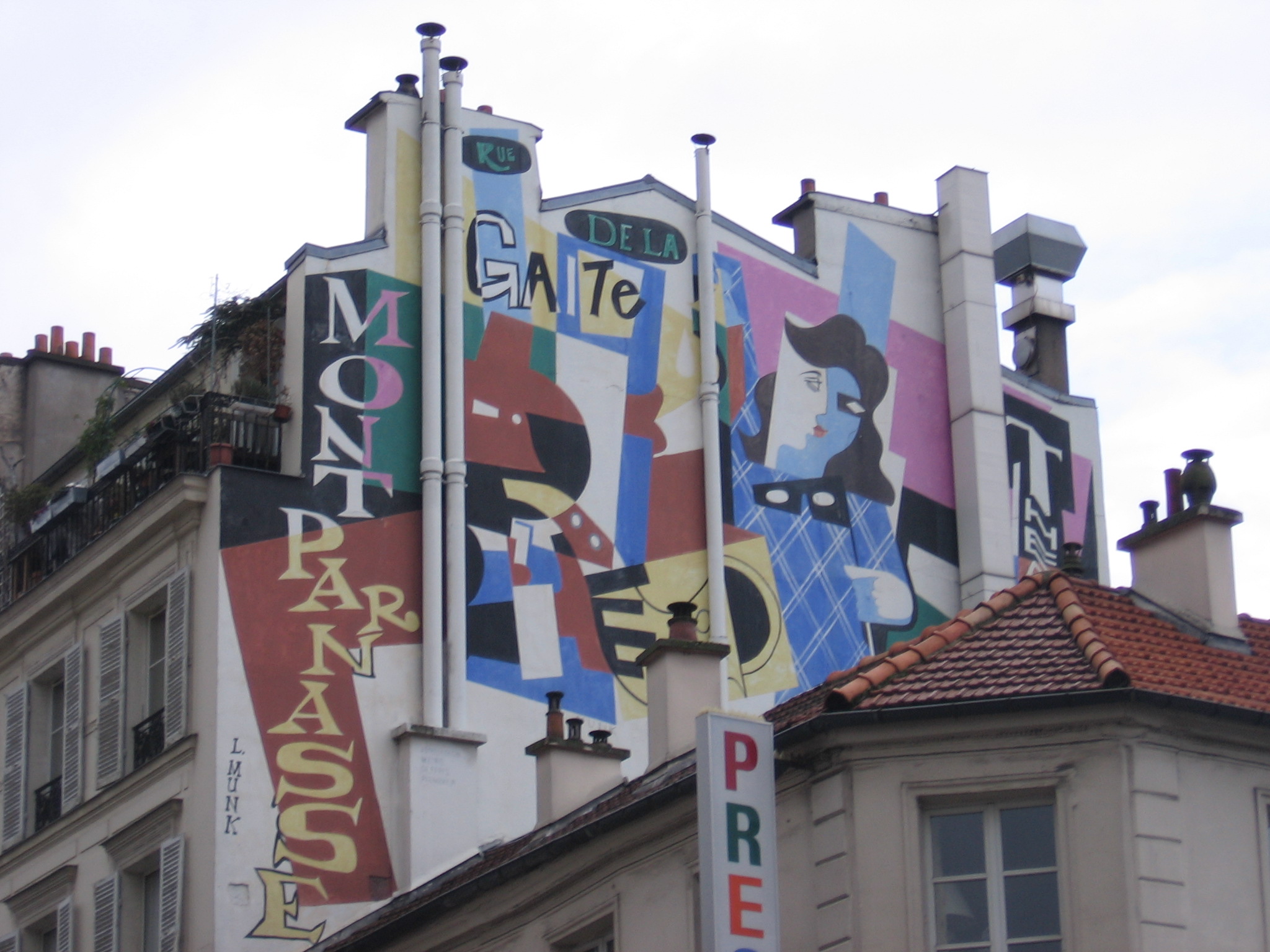
A building in Montparnasse painted, no doubt, in
tribute to the many artists that have frequented it's streets.
The novel’s protagonist, Detective Aimeé Leduc, gets caught up in a bit of this history herself, having been mysteriously enlisted by a Russian man named Yuri Volodya to protect a – you guessed it – prized Modigliani painting.  Aimeé is thrown into what seems to be Black’s bizarre and twisted take on the embodiment of Golden Age Syndrome, where the seemingly desirable sensibilities of a highly romantic age are shrouded in deceit and betrayal. 

If you would like to get a taste of what Black’s novel has to offer, I suggest visiting the Soho website, where you will find a large excerpt of the novel available.  If you like what you see – and I have no doubt you will – there is further good news.  Murder Below Montparnasse is just one in a series of thirteen murder mysteries by Cara Black, which collectively comprise the Aimeé Leduc investigations.  Each book in the series is set in a different section of Paris; together they are a literary map, rich in French cultural history and insight into the delightfully seductive Parisian landscape.

Learn more about Cara Black, and get a chance to meet her on her nationwide book tour by clicking here.

- Colleen McClintock

Monday, February 25, 2013

Another Soho Press Success


"Laughter is a subversive weapon when you live under a repressive regime. That's the take-away lesson from Colin Cotterill's gravely funny novels set in Indochina in the 1970s."
Soho Press continues to gain recognition from readers worldwide, widening eyes with their new mystery title, The Woman Who Wouldn't Die. This long-awaited follow-up to 2011's Slash & Burn and the ninth installment in Colin Cotterill's bestselling mystery series stars the inimitable Lao national coroner, Dr. Siri, a man extraordinarily intrigued by the dead souls he examines every day.
After a woman is shot and killed in her bed during a burglary and her body burned in traditional Lao fashion, she pulls a Lazarus, reappearing three days later with only one distinguishing difference; she can now communicate with the dead. Her clairvoyance persuades the long-dead brother of a Lao general to enlist her in helping his brother uncover his remains, which have been lost at the bottom of a river for many years.
Dr. Siri is sent along to supervise the excavation, and convinced that this will be a relaxing voyage, he persuades his wife, Madame Daeng, to join them. However the couple’s vacation soon turns into a thought provoking journey when questions arise concerning what the group is really digging for at the bottom of this remote river on the Thai border.
Soho Press is a phenomenal independent publisher of literary fiction and international crime. Their recent recognition by the New York Times comes to no surprise. Since 1986, they have been releasing attention-garnering titles such as The Woman Who Wouldn’t Die, and will certainly continue to do so in the upcoming years. To check out their full catalogue including all 2013 releases, visit their site at www.sohopress.com.
-Mike Iovino