Showing posts with label For Beginners. Show all posts

Friday, April 5, 2013

Napalm: An American Biography by Robert Neer

Napalm. We think we know what it is. We know that, whatever the exact chemical ingredients it contains, napalm burns; human flesh, buildings, trees…everything. A hot, sticky goo that’s impossible to put out.

Sure, you know about napalm. You’ve probably seen Apocalypse Now. But how did we get ahold of this powerful substance? Why was it once considered appropriate for war but now condemned? What are the societal and political implications of napalm and the horrors it has reaped? Robert Neer (Barack Obama For Beginners) answers these difficult to process questions in Napalm: An American Biography.

“Napalm, incendiary gel that sticks to skin and burns to the bone, came into the world on Valentine’s Day 1942 at a secret Harvard war research laboratory. On March 9, 1945, it created an inferno that killed over 87,500 people in Tokyo—more than died in the atomic explosions at Hiroshima or Nagasaki. It went on to incinerate sixty-four of Japan’s largest cities. The Bomb got the press, but napalm did the work.”

"Robert Neer has written the first history of napalm, from its inaugural test on the Harvard College soccer field, to a Marine Corps plan to attack Japan with millions of bats armed with tiny napalm time bombs, to the reflections of Phan Thi Kim Phuc, a girl who knew firsthand about its power and its morality." 

Napalm, which is the first ever history on this terrifyingly powerful substance, debuted in March. Within the book Neer explains the history of napalm, the uses, the horrors, and societal views regarding napalm and its use in war.
Neer explains how the makers of napalm intended for the substance to burn things not people. Despite this, napalm has been used in just about every war since WWII, including Iraq. Neer explores how napalm, once a respected weapon, became the target of outrage and protest during the Vietnam War. Who can forget the horrific photo of Kim Phuc, pure terror on her face, running naked down a Vietnamese street? The photo is too horrific for me to post but a simple Google search should suffice. “Today there is an international consensus against the use of napalm anywhere near civilians, but it’s still part of military arsenals.” 


In an interview with the Boston Globe, Neer explains how the Vietnam War transformed society’s view on napalm:
“Two things happened with Vietnam. For one thing, the United States lost the war, and since napalm had become for the protest movement a symbol of our misguided actions in Vietnam, this loss had profound consequences for the way people perceived the weapon. And the second thing was that coverage of the Vietnam War and specifically descriptions of the effect of napalm on civilians were far more dramatic and extensive than in World War II. In World War II, much of napalm’s impact was in Japan, where there wasn’t much opportunity for correspondents to report on what was happening at the time, because they couldn’t go there.”


“Fieser said that he never imagined napalm would be used against people. He thought it would be used to target things. And he devoted his entire life to medicines and chemicals that could help people. He helped synthesize Vitamin K. He was a beloved teacher to students at Harvard. He was part of team that determined smoking was a cause of death. So he’s a complex person. But with respect to his assertion that he never thought napalm would be used against people, it’s a little bit hard to completely credit that, since many of the tests that they did with the gel that they invented were on residential buildings, specifically on models of German and Japanese houses. The man was a genius, so it’s hard to believe he wouldn’t see the obvious implications of how it would be used.”


Neer has given us a much needed history on this powerful weapon. Napalm is something we think we understand with its many cultural references from Apocalypse Now to video games. But Neer's book provides us with a much deeper, more useful background.


Wednesday, March 20, 2013

Akashic Writer, David McConnell Tries on Nonfiction; Says the Shoe Fits, Just Differently

Akashic author, David McConnell alongside the cover of
his new book, American Honor Killings:
Desire and Rage Among Men
What can be said when a writer leaves his or her fiction post, if only temporarily, to take on something harder, more factual?  It’s an interesting move, given that a fiction writer’s whole professional existence is heavily shrouded in the unreal.  It’s almost like a singer deciding to put the old pipes to rest and pick up some drumsticks; same general area but still is, for the most part, all new territory.

Yet, when novelist David McConnell describes the method to the madness of his new non-fiction book, American Honor Killings: Desire and Rage Among Men, it all makes perfect sense.  The book, released from Benay client Akashic Books just two weeks ago, is pretty much the non-fiction cousin of his previous two novels, The Firebrat and The Silver Hearted.  The subject matter is unanimous; very young, typically foolish male protagonists who get tangled in their respective webs of extreme bias and violence. 

In 2003 McConnell brought The Firebrat to life through the tale of an aspiring, witty writer who decides to out him and his subsequently outraged partner via short story.  The firestorm that commences sends the young man through a crash course of identity change that even his cocky intelligence can’t best.  In 2010 McConnell wove another tale of crime and secrecy in the context of a wartime seaport.  An old wino and a naïve sailor must band together to hide the fortunes of a few shady investors, but their worldviews clash.  The drunkard’s power-trip and the naif’s moral conscious clash with unexpected and rather unpleasant results.

The "Betrayal" issue of Granta,
released, Spring 2013.
Intricate, no?  Except poring over the details of these two stories was not enough for McConnell.  He describes why in a recent interview with Patrick Ryan, Associate Editor for Benay’s other client, Granta Magazine.

“I wanted to do something more urgent than wordsmithing in my mansard,” McConnell explains. “Violence has always loomed large for me as an imaginary thing. But violence is also on our cultural stage in a way it hasn’t been in earlier generations.”

Right you are, Mr. McConnell. 

With tragedies like Sandy Hook happening right in Benay’s very own backyard, we know all too well what he means.  Though American Honor Killings does not deal with quite that same situation, it stays along the same vein.  The book recounts six cases in which young men, harboring large amounts of seemingly irrational violence in them, have lashed out and killed.  The victims in each and every one of these cases were all homosexual men.  McConnell’s book specifically tries to crack the logic behind these killings, delving deep into the psyche of unstable, hate-ridden young men like his featured perpetrators.

McConnell writes in his book about one specific murder that it was driven by “an authentic instance of hatred that can’t be psychologized away – an idea of what’s right, not simple emotion, caused him to kill.”  When Patrick Ryan addresses this statement in the Granta interview, asking why it is not a case of the famously coined term “gay panic,” McConnell explains that all of the killers he writes of were reasoning individuals that used a “sober world view” throughout all of their actions.  “I’d say the crimes all primarily involve a diseased sense of self,” says McConnell, “more than they involve anything like a reaction to another, very different, human being.”

It is in this that McConnell’s own reasoning behind his book is revealed.  A writer can make a character as fascinating or as dull as they would like, but in the end it is just a character, and their perverse and violent world holds the sanctity of the fact that, in the end, it is not real.  It’s only natural that David McConnell came to realize this and, having dealt with such pressing subject matter, could no longer resist the temptation to dive into it for real.

To view excerpts from American Honor Killings: Desire and Rage Among Men please click here, where you can peruse sample pages and/or purchase the paperback and digital editions.  Please feel free to visit the Akashic and Granta websites and browse the additional upcoming features and titles that both publishers have to offer - they have much authorial talent, old and new, at your disposal.

- Colleen McClintock

Monday, March 18, 2013

Tin House and Granta Set the Gender Bar for Publishers Nationwide


Could we be any more proud of our clients?  After seeing the official results from the March 4th VIDA count, probably not.  Benay clients Tin House and Granta were rated by VIDA as two of the most progressive publishers these days when it comes to gender equality.  Out of the fifteen that were reviewed by VIDA they and the Boston Review were the only ones to find that they were balanced between men and women in editors, reviewers, contributors, and otherwise.  The remaining twelve were shown to be starkly in favor of women.

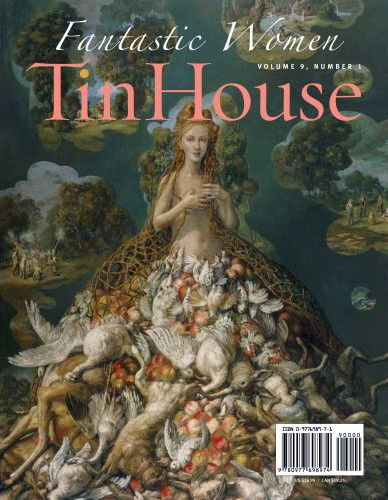
The "Fantastic Women" issue of
Tin House, issued Fall 2007
“It isn’t rocket science” – the very words of Tin House Editor, Rob Spillman as quoted in a recent article on the pop culture blog, Flavorwire.  Spillman states, “…you would think others would move toward gender equality, or at least make a gesture toward it… for us the VIDA count was a spur, a call to action.”

How right he is.  The numbers of the VIDA count were dismal in many cases.  The New Yorker results showed roughly two and a half times as many men were employed in all categories; The New York Review of Books was even more imbalanced at around five times as many male contenders in all categories.

Not surprisingly, Tin House was singing somewhat of the same song not too long ago.  The difference is in the way they handled it.  The editorial team saw that even though they asked for an even split of writers to cover, people just kept writing more about male authors.  So what did they do?  They did what any truly proactive, progressive publisher would do – they got über deliberate.  Spillman and his team decided to section off a chunk of time every editorial meeting to re-evaluate the gender balance.  If it is off-kilter they fix it.  It’s as simple as that, no fuel cell chemical equation required.

Those over at Granta take an even simpler approach; they take gender out of the equation altogether.  For Editor John Freeman it is not a matter of the best female writers and the best male writers featured in his magazine, it is the best writers.  He seems to find that middle part erroneous.

“I don’t force myself to think of Louise Erdrich, or Karen Russell,” Freeman says in the Flavorwire article. “In fact, it is hard for me not to [think about them]; to me, they are simply the best out there.”
American Dream Machine author
Matthew Specktor with his daughter.
Now it is not as if this means that the writers at Tin House and Granta, respectively, are chosen out of gender equal merit.  Matthew Specktor’s novel American Dream Machine set to release from Tin House next month hardly holds any female characters at all.  It is a story, told from male protagonist Nate Rosenwald’s point of view, about his one-time successful talent agent father Beau Rosenwald.  Nate relates the story of his father’s personal reinvention as he starts up his own agency, the American Dream Machine, with friend and consequent business partner, William Farquarson.

It is a son-and-father tale to beat the best of them, and there is nothing wrong with that.  As a recent review of Specktor’s novel on bookbrowse.com says, this novel may be all about men but it is by no means only for men.  In the novel Nate narrates with a distinctly authorial voice, channeling Specktor himself when he says, “This story… isn't about some bored actress and her existential crises, a troubled screenwriter who comes to his senses and hightails it back to Illinois. It's not about the vacuous horror of the California dream. It's something that could've happened anywhere else in the world, but instead settled, inexplicably, here.”

Hearing the novel put in this light, it isn’t really surprising, then, that it’s coming out of Tin House.  It could happen to anyone - it is applicable to anyone, un-biased and free from pretense.

- Colleen McClintock


Monday, March 11, 2013

Soho Press's Cara Black has done it again - and this time in Montparnasse!


Murder Below Montparnasse
author, Cara Black
I think it’s a bit indisputable that today’s generation of young Americans very accurately channels the wily ex-pats of the 1920s.  Frankly, we pride ourselves on it.  Any of my friends would give anything to romp around the glowing Paris streets at night, sipping Sazerac to their hearts delight, dancing with Djuna Barnes, and musing to F. Scott and Zelda about what is to be young and alive.  They are sensibilities that we can’t help but feed into; it’s the artist in all of us!

This is precisely why, when I say Cara Black’s new novel Murder Below Montparnasse has nailed it, I’m talking down into the floorboards for good.  Black takes all of the young dreamer sensibilities that are relevant today and mixes them with her characteristically elusive, keep-you-guessing style to create a new and exciting genre of literature that’s at once accessible and complex.

Marilyn Stasio lauds Black in her recent New York Times book review, calling Montparnasse a neighborhood, “rich… for the purposes of a plot that hangs on a Modigliani canvas and involves Russian émigrés and Surrealist artists…” – and boy is she right.  Montparnasse is historically one of the most artistically concentrated areas of Paris, hosting painters, poets and writers like Picasso, Joyce and Hemingway in its sprawling bars and cafes.  
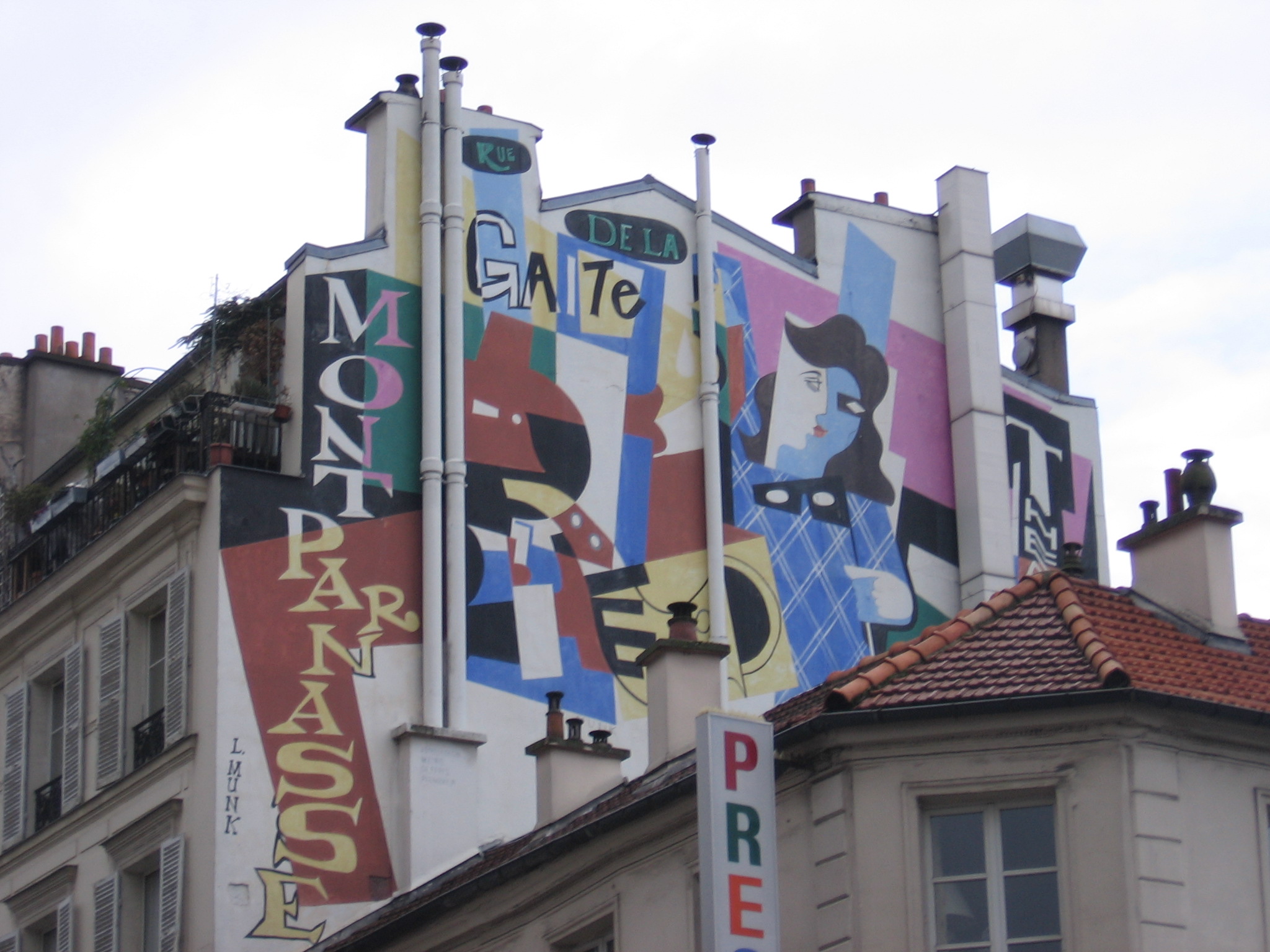
A building in Montparnasse painted, no doubt, in
tribute to the many artists that have frequented it's streets.
The novel’s protagonist, Detective Aimeé Leduc, gets caught up in a bit of this history herself, having been mysteriously enlisted by a Russian man named Yuri Volodya to protect a – you guessed it – prized Modigliani painting.  Aimeé is thrown into what seems to be Black’s bizarre and twisted take on the embodiment of Golden Age Syndrome, where the seemingly desirable sensibilities of a highly romantic age are shrouded in deceit and betrayal. 

If you would like to get a taste of what Black’s novel has to offer, I suggest visiting the Soho website, where you will find a large excerpt of the novel available.  If you like what you see – and I have no doubt you will – there is further good news.  Murder Below Montparnasse is just one in a series of thirteen murder mysteries by Cara Black, which collectively comprise the Aimeé Leduc investigations.  Each book in the series is set in a different section of Paris; together they are a literary map, rich in French cultural history and insight into the delightfully seductive Parisian landscape.

Learn more about Cara Black, and get a chance to meet her on her nationwide book tour by clicking here.

- Colleen McClintock

Thursday, March 7, 2013

Hanover Publisher Services: A Helping Hand for Indie Publishers


There has been some new and exciting developments for Benay client, Steerforth Press. They have officially debuted their small press distribution unit, Hanover Publisher Services.

Hanover Publisher Services has been around since early 2010, although they were never formally introduced to the public. Publisher’s Weekly states, “HPS evolved from an informal relationship with its distributor, Random House Publisher Services that allowed the indie house to offer select small presses—with the approval of RHPS—distribution via RHPS, which generally will only work with publishers with more than $500,000 in sales.”

Chip Fleischer, President of HPS and Publisher of Steerforth Press, explains how RHPS president Jeff Abraham expanded Random House’s distribution services. However, RHPS was reluctant to take on small clients. This is where Hanover Publisher Services stepped in. According to Fleischer, HPS “’enables Steerforth to leverage its good working relationship with RHPS and its good understanding of RHPS's complex operating systems.’”

In other words, HPS works for the little man. They get the independent publishers to the mainstream distributor. The whole process is streamlined because, Fleischer noted, ‘it's the same as having a single publisher client with multiple imprints.’” A win-win for everybody.

HPS currently has five clients including For Beginners, Campfire Graphic Novels, New Europe Books, Steerforth and their newest addition, Brooklyn-based Archipelago Books. Fleischer “said that HPS is taking a ‘go slow’ approach to adding new clients, but he also said he will consider adding more publishers if they are ‘the right fit.’”

Read the two articles on this exciting new development here and here.

Wednesday, March 6, 2013

It's A Bird! It's A Plane! No, it's... SOHO PRESS!


After last week’s blog on success story, Colin Cotterill, and his fresh new novel The Woman Who Couldn’t Die, we once again must pay tribute to the powerhouse publisher and Benay client, Soho Press.

Jim Milliot’s review last week in Publishers Weekly gave Soho Press my – and I’m fairly sure, everyone’s – undivided attention.  Milliot cites the company as having a 96% sales increase from last year’s period, alone.  That’s higher than any other independent publisher across the nation, including Other Press, a neighbor of Soho in Manhattan, BenBella Books out of Dallas, Smithsonian Books out of Washington, D.C. and Ulysses Press over in Berkeley, California.

So what has this stellar valedictorian done to reach the top of its class?  Milliot gives us the inside scoop on four key steps that the publisher has taken to achieve such astronomical success:
Digital Publishing: In last two years Soho has focused many of its efforts on developing the digital sector of the company.  In 2012 e-books accounted for just over half of the company’s total sales, with the format representing 43% of sales for literary titles and 67% of the titles under the Soho Crime imprint.

Marketing and Publicity: Soho nearly doubled their promotional budget from January of 2011 and gave a slight increase to the numbers behind the marketing and publicity team.  They also broadened their advertisement horizons, sticking to traditional media mediums while utilizing the social media boom to their utmost advantage.

Distribution Reform: Seeing the opportunities that could come from working through a large-scale distributor, Soho turned to Random House for distribution services in January 2011 and broadened their outreach significantly, reaching audiences overseas.

General Growth:  In 2013 Soho plans to launch a new imprint for young adult novels called Soho Teen.  The new addition will add 12 titles to the 64 titles that the company has already published.

Soho Press Publisher, Bronwen Hruska
And the best part, if you can even believe that it get better - they are just so darn down-to-earth!  Look no further than the About Us page to see for yourselves.  Among other things, the Soho team boasts the qualities of a former cactus model, self-proclaimed habitual defector, and greek yogurt lover.  Publisher Bronwen Hruska pokes a bit of fun at herself, saying “None of the screenplays [I] sold were ever made into movies so you can’t watch them.” 

Hruska has had a bit of additional success recently with her book Accelerated – a gripping commentary on the tendency that our society has to jump the gun on ADD and ADHD diagnoses in children.

All in all, she and her team seem to achieve the embodiment of modern grace, thriving in the fast-paced culture of today’s business world without selling their souls.  It’s one of the more refreshing things I’ve seen to date.  I’d recommend Soho for any young professional as a good business model simply because, ladies and gentlemen, Soho Press is on fire.

If you’d like to learn more about Soho Press, visit their website at http://www.sohopress.com/

- Colleen McClintock

Friday, March 1, 2013

An Intern's Farewell


Put down that spoon!

Now that that’s out of the way, I can tell you about my experience as an intern at Benay Enterprises. Today marks the final day of my internship. Though, I am happy to have gained an invaluable experience over the past 5 months, the time has come for me to explore other options and take advantage of the opportunities that lie ahead. However, the beginning of the rest of my life may not have been if it weren’t for this unbelievable organization, as my experience here has instilled within me the qualities I will need to succeed in life.
The bittersweet end approaches ever so swiftly. With only an hour left in my time here, I cannot help but to look back to 5 months ago, when I first joined the Benay team. I had absolutely no office experience; I didn’t even know how to operate the scanner properly. Still, Dawn saw a quality within my writing that gave her the impression I could play a unique and necessary role in the office. She believed in me as a writer, and took a chance on a young guy who was fresh out of college.
Merrilee, Susan, and the rest of the friendly Benay employees took the time to teach me the ropes, no matter how busy they may have been handling royalties, back office functions, or bookkeeping needs for their valued clients. Eventually, with lots of trial and error, I became a functioning part of the well-oiled machine that is Benay. 
Witnessing first-hand the hard work and dedication it requires to run a business smoothly has paid dividends and has taught me a new level of professionalism, one which I will undoubtedly carry myself with for the remainder of my career. Moreover, the time each Benay staff member has dedicated to helping me grow as an individual will forever be appreciated.
Just last week, I walked into a job interview in midtown Manhattan, and even though there were dozens of applicants in the waiting room with me, I knew I was going to get the job. I knew that once I got the chance to tell the board members about my experience with Benay, all the qualifications I had surmounted in such a short period of time, they would not be able to turn me away. Sure enough, I received a call even before I could get home, and the job was mine.
Benay Enterprises tells their clients, “Do what you do best, and let Benay do the rest.” Well, the same statement holds true for my experience here as an intern. I was given the creative control over the company’s blog, and my blogs received quite a bit of attention, resulting in a recent offer to write a column for a local Danbury news site, The Mercurial, that had been re-publishing some of my blogs all along. Furthermore, FLW Magazine, the leading publication in the world of bass fishing (my other passion), was so impressed with the promotional pieces I wrote for Benay and For Beginners, they decided to give me a monthly one page article in their nationally circulated magazine.
Though I would like to say that I have done as much for Benay as Benay has done for me, I simply cannot because this company has given me the exposure and important contacts I needed in order to break into the world of writing. The experience alone has been worth more than my entire undergraduate career, and for that I cannot thank Benay enough. However, I am now moving on to work and write copy for an organization in Manhattan. Though I am destined to a dreadful commute, I look forward to this opportunity that never would have happened without Benay Enterprises. As a side note, if anybody out there is looking for a roommate within a short commute to the city, feel free to let me know J. More importantly, and I don’t have to say this because I won’t be here tomorrow to face any sorts of consequences should I admit otherwise, if you or your organization is ever in need of financial services or back office functions, I highly recommend you get in touch with the dedicated professionals and bookkeepers at Benay Enterprises.
For the last time,
-Mike Iovino

Friday, February 15, 2013

The Second Story of Every Title (As Told By a Bunch of ‘Ooligans)

A book is far more than a compilation of pages and text sandwiched between two covers; a book is labor in print, the culmination of countless hours spent on writing, revising, printing and promoting. As an author in my own right, each of my works is a part of me. Whether in a blog like this one, a piece of poetry, or a novel, every single word in print is carefully crafted in order to evoke a specific emotion from the audience. However, the author is not the only one who works on a title. Though they are the creative minds behind their texts, the public eye would never have access to their works without the essential medium, the catalysts of the written word, Publishers.
Publishing is hard work. The past four months I have spent as an intern at For Beginners and Benay Enterprises have proven that without a doubt. Working on webpages, drafting press releases, securing rights, dealing with agents, among many other things, working for a Publisher requires a multitude of skills in various fields. My internship at For Beginners and Benay has armed me with the skills I need in order to succeed in the world of Publication, but there are many interested in the field that do not have access to the unique and incredible opportunity I have had the privilege of experiencing.
There is, however, one University providing interested students with a glimpse into the fast paced field of publishing. Portland University’s Ooligan Press, an entirely student-staffed press, has recently implemented a program called “Start to Finish,” in which the students give an insider’s perspective on creating a book. Tracking the evolution of a title from acquisition to release date, students blog about their experiences during a title’s long journey to the printing press.
The response from participating students has been overwhelmingly positive. After working on Eliot Treichel’s story collection, Close is Fine, one student credited the project with “helping [her] to overcome [her] fear of taking on something bigger than [her]self.” Creator of Start to Finish, Jonathan Stark, said it best, “Each book we publish has an epic story of success behind it that exists totally separately from how well it reads or how well it sells.” Thus, the concept of the so-called “second story,” the story of a title’s creation that remains absent from the story in print yet is of just as much importance as the author’s writing.
Though it often remains unheard, the second story is responsible for the first. The literature audiences read and love would not exist without the Publisher, something both the students at PSU’s Ooligan Press and I know quite well. So next time you pick up a book, whether it be an informative and reader-friendly For Beginners title, a book from one of Benay’s publishing clients, or perhaps a recent release from Ooligan Press, take time to appreciate the hard work it took to put that book in your hands.
-Mike Iovino

Monday, August 9, 2010

Happy Third Birthday For Beginners!!!

Our friends and clients over at For Beginners Books are celebrating their third birthday in a very big way.

They're giving away all thirty-eight of their titles (that's right, a full catalog) to one talented individual who writes them a catchy and fun tagline for their graphic non-fiction series.

Be that lucky winner. Send them your ideas for a tagline by posting it on their facebook wall, at the facebook event page, post it in the comment box of their blog, email it to them at info@forbeginnersbooks.com, or tweet it on Twitter with the hashtag #ForBeginners.

Good luck and Happy Birthday For Beginners!