Monday, April 15, 2013

TIP: I-9 & COBRA Can Bite You for Incomplete Paperwork


Irked about the new Form I-9? Want to avoid the sting of COBRA non-compliance?

It's better to fill out than pay up - and here's why:

Form I-9 Regs

The Immigration Reform and Control Act (IRCA) of 1986 requires all employers to verify a new hire's authorization to work in the United States by completing Form I-9. Section 1 of the I-9 must be completed on the employee's first day of work for pay, and Section 2 must be completed within 3 business days of the employee's first day of work.

The I-9 form is comprised of 8 pages of instruction, making it a heavy enough load to intimidate new hires from filling it out, so employers might not get it back from them at all. Yet, because it is the responsibility of employers to complete and retain the form, you can potentially suffer a penalty of $110 per day, dating back to the period the forms should have been completed.

Let's put this in context. If you didn't get and retain the I-9 from a hire, say, 2 years ago, and you were audited by the Immigration and Customs Enforcement (ICE), you might be liable for anywhere up to $80,300 in fines. Believe it or not, there are real cases of companies being fined more than $1 million dollars.

Don't Let COBRA Bite You!

Employers can also potentially meet similar circumstances with the Consolidated Omnibus Budget Reconciliation Act (COBRA), the law giving certain workers and their families who lose their health benefits the right to choose to continue their group health plan for limited period of time. Employers that fail to offer the benefits of COBRA in a timely manner can be hit with an excise tax of up to $200 per day - even more than the I-9 penalty.

Fear not, however. All that is needed is an Offer of Insurance letter and proof that the former employee either accepted or declined it. It's amazing how many headaches the price of one stamp can prevent!

Do What You Do Best, and Let Benay Do the Rest!

Our job at Benay is to handle all of these back-office issues for employers.

We make sure that our clients have their new employees fill out the new I-9 forms, which were published as of March 8, 2013, and ensure they are being used by May 7, 2013. Additionally, we retain these records on behalf of our clients for the period required by ICE. 

We also take care of all COBRA letters and documentation for our client's former employees, making sure nothing slips through the cracks.

Benay does all of the behind-the-scenes documentation, filing, and more. If you'd like to spend more time growing your business and less time managing your back office, give us a call.

Friday, April 5, 2013

Napalm: An American Biography by Robert Neer

Napalm. We think we know what it is. We know that, whatever the exact chemical ingredients it contains, napalm burns; human flesh, buildings, trees…everything. A hot, sticky goo that’s impossible to put out.

Sure, you know about napalm. You’ve probably seen Apocalypse Now. But how did we get ahold of this powerful substance? Why was it once considered appropriate for war but now condemned? What are the societal and political implications of napalm and the horrors it has reaped? Robert Neer (Barack Obama For Beginners) answers these difficult to process questions in Napalm: An American Biography.

“Napalm, incendiary gel that sticks to skin and burns to the bone, came into the world on Valentine’s Day 1942 at a secret Harvard war research laboratory. On March 9, 1945, it created an inferno that killed over 87,500 people in Tokyo—more than died in the atomic explosions at Hiroshima or Nagasaki. It went on to incinerate sixty-four of Japan’s largest cities. The Bomb got the press, but napalm did the work.”

"Robert Neer has written the first history of napalm, from its inaugural test on the Harvard College soccer field, to a Marine Corps plan to attack Japan with millions of bats armed with tiny napalm time bombs, to the reflections of Phan Thi Kim Phuc, a girl who knew firsthand about its power and its morality." 

Napalm, which is the first ever history on this terrifyingly powerful substance, debuted in March. Within the book Neer explains the history of napalm, the uses, the horrors, and societal views regarding napalm and its use in war.
Neer explains how the makers of napalm intended for the substance to burn things not people. Despite this, napalm has been used in just about every war since WWII, including Iraq. Neer explores how napalm, once a respected weapon, became the target of outrage and protest during the Vietnam War. Who can forget the horrific photo of Kim Phuc, pure terror on her face, running naked down a Vietnamese street? The photo is too horrific for me to post but a simple Google search should suffice. “Today there is an international consensus against the use of napalm anywhere near civilians, but it’s still part of military arsenals.” 


In an interview with the Boston Globe, Neer explains how the Vietnam War transformed society’s view on napalm:
“Two things happened with Vietnam. For one thing, the United States lost the war, and since napalm had become for the protest movement a symbol of our misguided actions in Vietnam, this loss had profound consequences for the way people perceived the weapon. And the second thing was that coverage of the Vietnam War and specifically descriptions of the effect of napalm on civilians were far more dramatic and extensive than in World War II. In World War II, much of napalm’s impact was in Japan, where there wasn’t much opportunity for correspondents to report on what was happening at the time, because they couldn’t go there.”


“Fieser said that he never imagined napalm would be used against people. He thought it would be used to target things. And he devoted his entire life to medicines and chemicals that could help people. He helped synthesize Vitamin K. He was a beloved teacher to students at Harvard. He was part of team that determined smoking was a cause of death. So he’s a complex person. But with respect to his assertion that he never thought napalm would be used against people, it’s a little bit hard to completely credit that, since many of the tests that they did with the gel that they invented were on residential buildings, specifically on models of German and Japanese houses. The man was a genius, so it’s hard to believe he wouldn’t see the obvious implications of how it would be used.”


Neer has given us a much needed history on this powerful weapon. Napalm is something we think we understand with its many cultural references from Apocalypse Now to video games. But Neer's book provides us with a much deeper, more useful background.


Wednesday, April 3, 2013

The Literary Group International: The Force Behind that Book on Your Nightstand

Do you enjoy autobiographies of pop culture figures like Tia Mowry or Tyrese Gibson?  Is that tome of long-lost Beatles photos on your coffee table the object of your friends' curiosity? 

If you answered yes, you can thank Benay's client, The Literary Group International (that's LGI to countless authors.)

The Author's Agent

LGI  is one of the world's most successful literary agencies.  Their impressive titles range from #1 New York Times best-seller (and movie), October Sky by Homer Hickam to the True Crime book turning future Scorsese movie about the disappearance of union boss Jimmy Hoffa, I Heard You Paint Houses by Charles Brandt.

Founded in 1986 by agent Frank Weimann, LGI's talented team of literary agents includes Katherine Latshaw and Jeff Silberman. The firm's stellar reputation attracts top-notch authors for representation in the tough world of publishing.

New Works from LGI Authors

  • Parenting: Illustrated with Crappy Pictures (Harlequin) by popular blogger Amber Dusick, who says her book is "a place to vent about the funny (and frustrating) day-to-day things that happened to me as a parent." (Details) 
  •  The New Jewish Table: Modern Seasonal Recipes for Traditional Dishes (St. Martin's Press), by Chef Todd Gray and his wife Ellen Kassoff Gray, serves up favorites from their Washington, DC restaurant, Equinox. We dare you to try Ellen's famous Pickled Vegetable and Minted Lemon Yogurt Falafel. (Details)  
  • The Big, Bad Book of Beasts (William Morrow/Harper Collins) by Michael Largo is an encyclopedic chronicle of the beasts that walk the earth and populate our nightmares. You'll find portraits of scary animals  ranging from the mighty lion to the elusive vampire beast, Chupacabra. (Details) 


Do What You Do Best, and Let Benay Do the Rest!


For 19 years Benay has provided financial and back office management services to LGI, allowing them to focus on what they do best - finding and developing great authors.

If you'd like to spend more time finding new business and less time managing your back office, give us a call.

Wednesday, March 20, 2013

Akashic Writer, David McConnell Tries on Nonfiction; Says the Shoe Fits, Just Differently

Akashic author, David McConnell alongside the cover of
his new book, American Honor Killings:
Desire and Rage Among Men
What can be said when a writer leaves his or her fiction post, if only temporarily, to take on something harder, more factual?  It’s an interesting move, given that a fiction writer’s whole professional existence is heavily shrouded in the unreal.  It’s almost like a singer deciding to put the old pipes to rest and pick up some drumsticks; same general area but still is, for the most part, all new territory.

Yet, when novelist David McConnell describes the method to the madness of his new non-fiction book, American Honor Killings: Desire and Rage Among Men, it all makes perfect sense.  The book, released from Benay client Akashic Books just two weeks ago, is pretty much the non-fiction cousin of his previous two novels, The Firebrat and The Silver Hearted.  The subject matter is unanimous; very young, typically foolish male protagonists who get tangled in their respective webs of extreme bias and violence. 

In 2003 McConnell brought The Firebrat to life through the tale of an aspiring, witty writer who decides to out him and his subsequently outraged partner via short story.  The firestorm that commences sends the young man through a crash course of identity change that even his cocky intelligence can’t best.  In 2010 McConnell wove another tale of crime and secrecy in the context of a wartime seaport.  An old wino and a naïve sailor must band together to hide the fortunes of a few shady investors, but their worldviews clash.  The drunkard’s power-trip and the naif’s moral conscious clash with unexpected and rather unpleasant results.

The "Betrayal" issue of Granta,
released, Spring 2013.
Intricate, no?  Except poring over the details of these two stories was not enough for McConnell.  He describes why in a recent interview with Patrick Ryan, Associate Editor for Benay’s other client, Granta Magazine.

“I wanted to do something more urgent than wordsmithing in my mansard,” McConnell explains. “Violence has always loomed large for me as an imaginary thing. But violence is also on our cultural stage in a way it hasn’t been in earlier generations.”

Right you are, Mr. McConnell. 

With tragedies like Sandy Hook happening right in Benay’s very own backyard, we know all too well what he means.  Though American Honor Killings does not deal with quite that same situation, it stays along the same vein.  The book recounts six cases in which young men, harboring large amounts of seemingly irrational violence in them, have lashed out and killed.  The victims in each and every one of these cases were all homosexual men.  McConnell’s book specifically tries to crack the logic behind these killings, delving deep into the psyche of unstable, hate-ridden young men like his featured perpetrators.

McConnell writes in his book about one specific murder that it was driven by “an authentic instance of hatred that can’t be psychologized away – an idea of what’s right, not simple emotion, caused him to kill.”  When Patrick Ryan addresses this statement in the Granta interview, asking why it is not a case of the famously coined term “gay panic,” McConnell explains that all of the killers he writes of were reasoning individuals that used a “sober world view” throughout all of their actions.  “I’d say the crimes all primarily involve a diseased sense of self,” says McConnell, “more than they involve anything like a reaction to another, very different, human being.”

It is in this that McConnell’s own reasoning behind his book is revealed.  A writer can make a character as fascinating or as dull as they would like, but in the end it is just a character, and their perverse and violent world holds the sanctity of the fact that, in the end, it is not real.  It’s only natural that David McConnell came to realize this and, having dealt with such pressing subject matter, could no longer resist the temptation to dive into it for real.

To view excerpts from American Honor Killings: Desire and Rage Among Men please click here, where you can peruse sample pages and/or purchase the paperback and digital editions.  Please feel free to visit the Akashic and Granta websites and browse the additional upcoming features and titles that both publishers have to offer - they have much authorial talent, old and new, at your disposal.

- Colleen McClintock

Tuesday, March 19, 2013

The Art House: RubiconSeven Transforms Derelict Post Office Depot in New Canaan, CT


NCC design students and judges for the Art House
Located near the New Canaan, CT rail station, the1940's Post Office Depot has stood closed and unused for decades. Imagine the possibilities for reusing a landmark shuttered for 60 years!

Benay's client RubiconSeven delivers unique land use development solutions that improve lives, improve the ecology and environment, and build a meaningful place that values both consumers and the community at large.

The Art House is a collaboration of RubiconSeven and the RubiconSeven Foundation to develop the cavernous space into a studio for established artists, who will work and teach art students from the region. 

The Art House recently invited design students from Norwalk Community College to create concepts for its sustainable, community-centered development. On March 14 students in NCC's Art, Architecture and Design program presented 25 designs, which emphasized multipurpose use along with environmentally friendly design. Key concerns are passive energy strategies and walkable integration with the surrounding New Canaan downtown.

The judges included New Canaan development officials as well as academics. They awarded honors based on historical sensitivity, an understanding of life, safety and building code concepts, as well as architecture and land use principles.

The top four winners of the NCC student competition were Dominika Fronckiewicz, Tetyana Fen, Aliaksandr Melko and Wonsun Oh. Congratulations!

According to RubiconSeven Principal Ted Bonner, NCC students produced outstanding ideas for this ground-breaking project. The participation of local students epitomizes the community-centered spirit of The Art House.  For details, visit arthousenc.org and facebook.com/arthousenc.

Do What You Do Best, and Let Benay Do the Rest!

Benay is proud to provide financial and back office management services to RubiconSeven, allowing them to focus on what they do best - developing great projects.

If you'd like to spend more time developing your business and less time managing your back office, give us a call.

Monday, March 18, 2013

Tin House and Granta Set the Gender Bar for Publishers Nationwide


Could we be any more proud of our clients?  After seeing the official results from the March 4th VIDA count, probably not.  Benay clients Tin House and Granta were rated by VIDA as two of the most progressive publishers these days when it comes to gender equality.  Out of the fifteen that were reviewed by VIDA they and the Boston Review were the only ones to find that they were balanced between men and women in editors, reviewers, contributors, and otherwise.  The remaining twelve were shown to be starkly in favor of women.

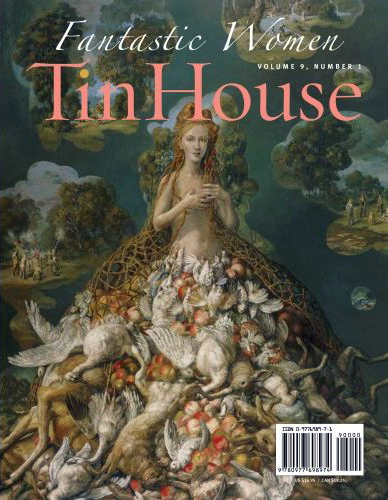
The "Fantastic Women" issue of
Tin House, issued Fall 2007
“It isn’t rocket science” – the very words of Tin House Editor, Rob Spillman as quoted in a recent article on the pop culture blog, Flavorwire.  Spillman states, “…you would think others would move toward gender equality, or at least make a gesture toward it… for us the VIDA count was a spur, a call to action.”

How right he is.  The numbers of the VIDA count were dismal in many cases.  The New Yorker results showed roughly two and a half times as many men were employed in all categories; The New York Review of Books was even more imbalanced at around five times as many male contenders in all categories.

Not surprisingly, Tin House was singing somewhat of the same song not too long ago.  The difference is in the way they handled it.  The editorial team saw that even though they asked for an even split of writers to cover, people just kept writing more about male authors.  So what did they do?  They did what any truly proactive, progressive publisher would do – they got über deliberate.  Spillman and his team decided to section off a chunk of time every editorial meeting to re-evaluate the gender balance.  If it is off-kilter they fix it.  It’s as simple as that, no fuel cell chemical equation required.

Those over at Granta take an even simpler approach; they take gender out of the equation altogether.  For Editor John Freeman it is not a matter of the best female writers and the best male writers featured in his magazine, it is the best writers.  He seems to find that middle part erroneous.

“I don’t force myself to think of Louise Erdrich, or Karen Russell,” Freeman says in the Flavorwire article. “In fact, it is hard for me not to [think about them]; to me, they are simply the best out there.”
American Dream Machine author
Matthew Specktor with his daughter.
Now it is not as if this means that the writers at Tin House and Granta, respectively, are chosen out of gender equal merit.  Matthew Specktor’s novel American Dream Machine set to release from Tin House next month hardly holds any female characters at all.  It is a story, told from male protagonist Nate Rosenwald’s point of view, about his one-time successful talent agent father Beau Rosenwald.  Nate relates the story of his father’s personal reinvention as he starts up his own agency, the American Dream Machine, with friend and consequent business partner, William Farquarson.

It is a son-and-father tale to beat the best of them, and there is nothing wrong with that.  As a recent review of Specktor’s novel on bookbrowse.com says, this novel may be all about men but it is by no means only for men.  In the novel Nate narrates with a distinctly authorial voice, channeling Specktor himself when he says, “This story… isn't about some bored actress and her existential crises, a troubled screenwriter who comes to his senses and hightails it back to Illinois. It's not about the vacuous horror of the California dream. It's something that could've happened anywhere else in the world, but instead settled, inexplicably, here.”

Hearing the novel put in this light, it isn’t really surprising, then, that it’s coming out of Tin House.  It could happen to anyone - it is applicable to anyone, un-biased and free from pretense.

- Colleen McClintock


Monday, March 11, 2013

Soho Press's Cara Black has done it again - and this time in Montparnasse!


Murder Below Montparnasse
author, Cara Black
I think it’s a bit indisputable that today’s generation of young Americans very accurately channels the wily ex-pats of the 1920s.  Frankly, we pride ourselves on it.  Any of my friends would give anything to romp around the glowing Paris streets at night, sipping Sazerac to their hearts delight, dancing with Djuna Barnes, and musing to F. Scott and Zelda about what is to be young and alive.  They are sensibilities that we can’t help but feed into; it’s the artist in all of us!

This is precisely why, when I say Cara Black’s new novel Murder Below Montparnasse has nailed it, I’m talking down into the floorboards for good.  Black takes all of the young dreamer sensibilities that are relevant today and mixes them with her characteristically elusive, keep-you-guessing style to create a new and exciting genre of literature that’s at once accessible and complex.

Marilyn Stasio lauds Black in her recent New York Times book review, calling Montparnasse a neighborhood, “rich… for the purposes of a plot that hangs on a Modigliani canvas and involves Russian émigrés and Surrealist artists…” – and boy is she right.  Montparnasse is historically one of the most artistically concentrated areas of Paris, hosting painters, poets and writers like Picasso, Joyce and Hemingway in its sprawling bars and cafes.  
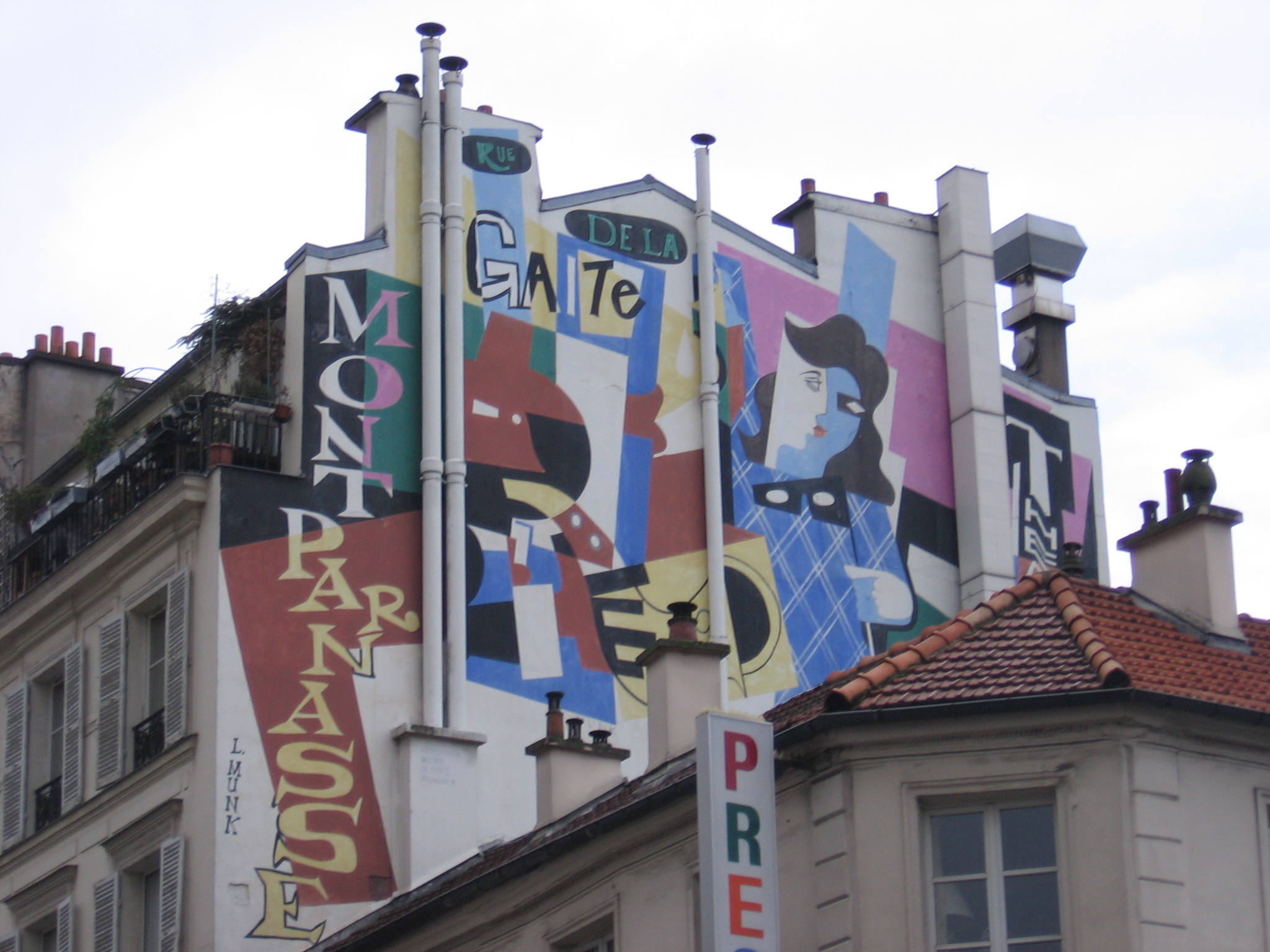
A building in Montparnasse painted, no doubt, in
tribute to the many artists that have frequented it's streets.
The novel’s protagonist, Detective Aimeé Leduc, gets caught up in a bit of this history herself, having been mysteriously enlisted by a Russian man named Yuri Volodya to protect a – you guessed it – prized Modigliani painting.  Aimeé is thrown into what seems to be Black’s bizarre and twisted take on the embodiment of Golden Age Syndrome, where the seemingly desirable sensibilities of a highly romantic age are shrouded in deceit and betrayal. 

If you would like to get a taste of what Black’s novel has to offer, I suggest visiting the Soho website, where you will find a large excerpt of the novel available.  If you like what you see – and I have no doubt you will – there is further good news.  Murder Below Montparnasse is just one in a series of thirteen murder mysteries by Cara Black, which collectively comprise the Aimeé Leduc investigations.  Each book in the series is set in a different section of Paris; together they are a literary map, rich in French cultural history and insight into the delightfully seductive Parisian landscape.

Learn more about Cara Black, and get a chance to meet her on her nationwide book tour by clicking here.

- Colleen McClintock